The global music industry is currently undergoing a transformation so profound that it rivals the invention of the phonograph or the shift to digital streaming. For decades, the fortress of high-quality music production was guarded by formidable barriers: expensive recording studios, years of technical training, and the prohibitive cost of hiring professional talent. Today, however, Artificial Intelligence is systematically dismantling those walls, ushering in an era of unprecedented democratization in sound. We are moving past the days when technology was merely a tool for correction—fixing pitch or quantizing drums—and entering a new epoch where AI acts as a sophisticated co-creator, capable of generating complex melodies, lyrical structures, and, most notably, realistic human vocals. This shift is not just technical; it is fundamentally altering the economic landscape of the digital music market, enabling a new generation of creators to participate in the global creator economy.
The Barriers Crumbled by Algorithms
The Cost of Quality vs. The Content Deluge
To understand the magnitude of this shift, one must first look at the traditional bottlenecks of music production. Historically, producing a radio-ready track was a financial gamble that required a significant budget, often involving a team of songwriters, producers, mixing engineers, and, crucially, talented vocalists. Hiring a professional session singer can easily cost hundreds to thousands of dollars per track, a price point that effectively excludes the vast majority of independent creators from achieving a "commercial" sound. This financial barrier stands in stark contrast to the modern world's insatiable appetite for audio content. According to Luminate’s mid-year report, an average of 120,000 new tracks were uploaded to streaming services daily in 2023. This figure highlights a massive disparity: the demand for music to fuel TikTok trends, YouTube backgrounds, and indie games is growing exponentially faster than human musicians can physically record it.
The "Vocal Gap" in Modern Production
For many bedroom producers and digital creators, the biggest hurdle has always been the voice. While affordable software has made it possible to produce professional-grade beats and instrumental arrangements on a laptop, capturing a high-quality vocal performance remains difficult. It requires a quiet room, expensive microphones, and a talented performer. This "vocal gap" often leaves tracks feeling unfinished or relegated to instrumental playlists, severely limiting their marketability in a pop-centric industry where the human voice is the primary connection point for listeners. This limitation has created a massive market vacuum, one that is rapidly being filled by the emergence of the AI Singing Voice Generator, a technology that promises to bridge the divide between instrumental proficiency and full song composition.
Inside the Engine: Neural Synthesis and Market Trends
Beyond Sampling: The Rise of Generative Vocals
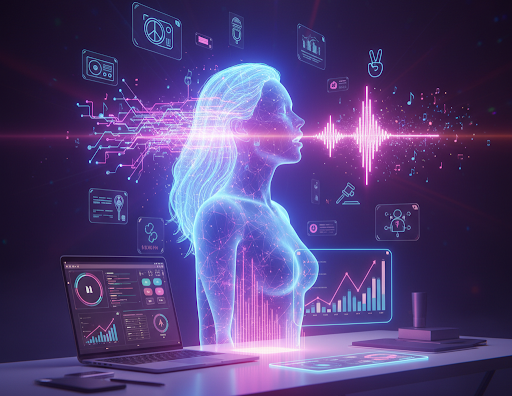
Modern AI music tools do not operate by simply cutting and pasting existing audio samples, which was the standard for decades. Instead, they utilize advanced Deep Neural Networks (DNNs) to "learn" the fundamental characteristics of sound. By analyzing the timbre, pitch, vibrato, and breath of human speech across thousands of hours of recordings, these algorithms can construct entirely new audio waves that mimic human performance with startling accuracy. This technological leap has given birth to the modern AI singing voice generator, allowing users to convert text and melody data into audio that is increasingly indistinguishable from a human recording. These tools are becoming central to the workflow of digital creators, enabling them to audition different "singers" for a track without ever booking a studio session.
The Aesthetic of the Algorithm in Pop Culture
The adoption of these tools is also being driven by shifting aesthetic preferences in the music market. AI and synthetic vocals are particularly effective in genres that already favor heavily processed sounds, such as Hyperpop, EDM, and Lo-Fi Hip Hop, which are currently dominating streaming charts. In these genres, a slightly "synthetic" or digital texture is often seen as a stylistic choice rather than a flaw. Furthermore, current social media trends show a massive spike in "Sped Up" or "Nightcore" versions of songs on platforms like TikTok. AI tools can generate vocals that maintain their fidelity even when manipulated for tempo and pitch, providing the flexibility required for these viral formats. This adaptability is a key driver in the marketization of synthetic vocalists, as they offer a level of malleability that recorded human audio simply cannot match.
From Text Prompt to Streaming Hit
A New Era of Composition and Workflow
The workflow for the modern digital musician is changing radically. It begins with a concept, often aided by AI composition assistants that suggest chord progressions or rhyme schemes based on a desired mood or genre. Once the instrumental foundation is laid, the creator faces the vocal challenge. This is where the magic of neural synthesis transforms the process. Instead of coordinating schedules with a singer, the producer selects a voice profile—perhaps a raspy rock singer for a high-energy track or a breathy pop tone for a ballad. Platforms like OpenMusic AI are emerging to bridge this gap, offering accessible interfaces that allow creators to harness these complex algorithms without needing to write code.
Post-Production and the Clean Digital Signal
Once the vocal is generated, it is treated like any standard audio file in a Digital Audio Workstation (DAW). Producers can apply reverb, compression, delay, and autotune to fit the vocal into the mix. One significant advantage of this workflow is the technical purity of the source material. Unlike home recordings, which often suffer from background noise, poor room acoustics, or microphone pop, the output from an AI generator is digitally pristine. This allows for a much faster mixing process, further accelerating the production timeline. This efficiency is critical for creators who operate on tight deadlines, such as YouTubers who need original music for daily vlogs or game developers iterating on sound design.
The Economics of Digital Sound
Monetization and Efficiency
The economic impact of AI in the music market is undeniable and multifaceted. By utilizing an AI singing voice generator, production overheads can drop by as much as 90%, effectively removing the cost of talent acquisition and recording studios. This reduction in cost allows independent artists and labels to release music more frequently, a strategy that is essential for triggering the algorithms of streaming platforms like Spotify and Apple Music. In the streaming economy, volume and consistency are often as important as quality, and AI provides the leverage needed to maintain a high output schedule.
Speed to Market and Licensing Opportunities
Beyond cost savings, the speed to market is a game-changer. Internet trends move at lightning speed; if a specific style of music goes viral on Monday, AI allows producers to release similar tracks by Tuesday to capitalize on the wave. Additionally, there is a massive, underserved market for royalty-free and stock music. Video creators constantly face copyright strikes for using commercial music. AI-generated music provides a scalable solution for this sector, allowing for the creation of vast libraries of "safe" music that can be licensed for video, advertising, and corporate use without the legal complexities of traditional rights management.
Weighing the Automated Scale: Pros and Cons
The Creative Explosion vs. The Human Touch
As with any disruptive technology, the rise of AI music brings both immense benefits and significant drawbacks. On the positive side, the accessibility is revolutionary; anyone with a laptop can now create full, radio-quality songs, unlocking a wave of creativity from people who were previously silenced by financial barriers. The variety is also limitless, granting producers access to an infinite palette of vocal timbres. However, the technology is not without its flaws. AI still struggles with the subtle, "imperfect" emotional nuances that make a human performance truly touching—the crack in a voice during a sad lyric or the spontaneous energy of a live ad-lib. Over-reliance on these tools risks leading to a homogenized musical landscape where everything sounds technically perfect but emotionally hollow.
Navigating the Legal Gray Zones
Copyright, Deepfakes, and Ownership
The rapid advancement of this technology has outpaced the legal framework, leading to complex ethical and copyright issues. The viral "Heart on My Sleeve" track, which used AI to mimic the voices of Drake and The Weeknd without their consent, raised massive legal questions about the "right of publicity." Using an AI vocal synthesizer to copy a specific celebrity is legally risky and ethically questionable. Furthermore, the question of ownership remains murky. Currently, the US Copyright Office has stated that works created entirely by AI cannot be copyrighted, although works with significant human input (such as human-written lyrics and melodies performed by AI) may be eligible for protection. Major labels like Universal Music Group are actively pushing back, advocating for the protection of "human artistry." Creators must navigate this landscape carefully, ensuring they use ethical tools trained on licensed or royalty-free data to avoid legal pitfalls.
The Future Frequency
The Hybrid Model of Creation
The integration of AI into music production is not a fleeting trend; it is a fundamental shift in the media production pipeline. The AI singing voice generator is transitioning from a novelty toy into a serious professional instrument. Looking forward, we are moving toward a hybrid model of creativity. Human musicians will continue to provide the vision, the emotion, and the "soul" of the music, while AI handles the technical execution and expands the sonic possibilities. This does not spell the end for human singers; live performance and genuine human connection remain irreplaceable experiences. However, for the digital market—where content is king and speed is currency—AI offers an efficiency that cannot be ignored. The tools are here, the market is listening, and the definition of what it means to be a "music maker" is expanding every day.